Aug 18, 2025
Mathematics often has a bad reputation, even among adults. But the truth is, when introduced in the right way, math can be exciting, creative, and even joyful. For young children,

In the early years of life, from birth to age 7, development is not just about visible milestones. It unfolds quietly through everyday movement, in crawling across the floor, reaching for a toy, climbing a step, balancing, gripping, and exploring.
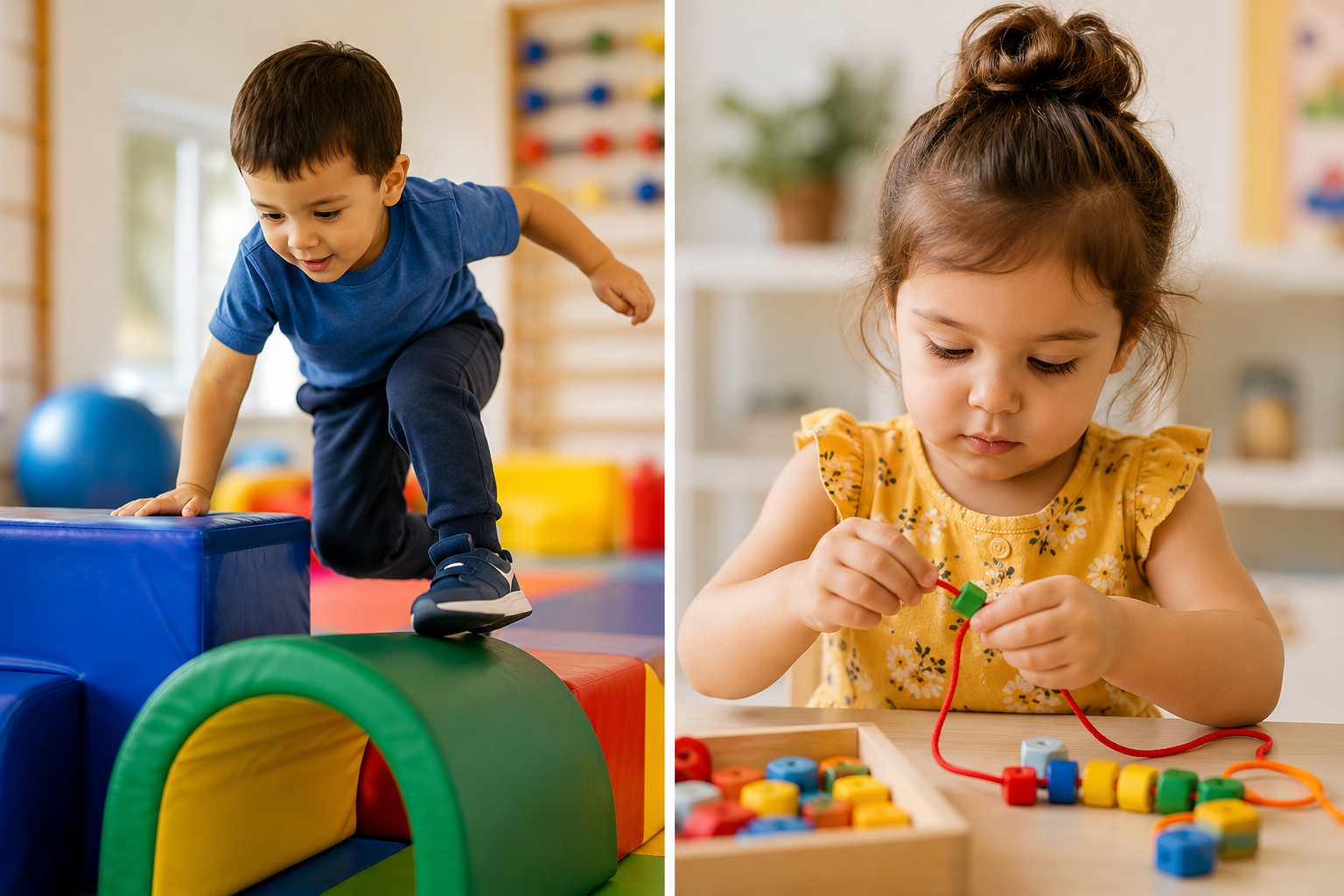
Some movements are big and energetic, like running, jumping, and spinning with laughter. Others are quiet and concentrated, like turning a page carefully, fastening a button, holding a crayon with intention.
These movements are the foundations of holistic development and they shape how a child’s brain grows, learns and connects with the world.
As parents, we often come across terms like gross motor skill and fine motor skill. And with a natural desire to give our children the best start, a common question arises — which one matters more? The answer is simple both matter equally.
Gross motor skills involve large muscle movements, which gets the whole body involved which are essential for gross motor development from 0–7 years of age.
These movements strengthen the arms, legs, and core muscles. But more importantly, they stimulate brain development.
When a child climbs a ladder or balances on one foot, the brain is actively:
This strengthens neural pathways that support coordination, balance, and spatial awareness.
Gross motor skills are not “just play.” They are the brain’s way of wiring itself through movement.
The foundations of gross motor development begin right from infancy through movements like rolling, crawling, sitting, and walking.
As children grow through the toddler and preschool phase, which is around 1–5 years, these movements become more coordinated and confident through running, climbing, jumping, and balancing activities.
Fine motor skills involve small, precise movements, particularly of the hands and fingers. These skills are closely linked to school readiness, independence, and concentration in children.
Fine motor skills require hand-eye coordination, control, focus, and muscle precision.
Fine motor development is closely linked to school readiness because it supports:
Fine motor skills do not develop suddenly when a child holds a pencil, but it develops eventually layered with simple movements and exploration.
You may begin to notice the foundations of fine motor development as early as infancy, through actions like grasping toys, reaching, climbing and finger movements.
As children grow through the toddler and preschool years which is around 1–5 years, these skills become more refined and coordinated through activities like scribbling, buttoning, and self-feeding.
When we look into early stages of development, naturally a question arises in the parents mind: which skill or developmental type is more important, which one is more beneficial for my child.
However, my answer will simply be a “NO’’ because both these skills are not competitors, they are partners.
When both works in coordination, it supports the development of the child fully.
When a child does activities like climbing or crawling, it helps build the child’s body strength and support posture and endurance.
At the same time, tasks like drawing, stacking, or fastening buttons refine control and concentration.
As children practice both, their coordination improves naturally, helping them move and work with greater ease.
Activities like catching a ball or climbing stairs help children use both sides of the body together.
This strengthens communication between the two hemispheres of the brain, essential for tasks like holding paper with one hand while writing with the other.
Before a child can grip a pencil with control, their arms and shoulders need strength.
Activities like swinging, hanging, crawling, or climbing naturally build this foundation.
These movements strengthen the muscles that support steady hand control and make detailed tasks like writing or drawing feel easier and more confident over time.
Running, jumping, and spinning stimulate the vestibular system (balance) and proprioceptive system (body awareness).
These sensory inputs help regulate attention and support better concentration during fine motor tasks.
When movement is balanced, the brain learns to coordinate efficiently.
The body becomes steady, and the hands become skillful.
Motor play, both large and small is one of the most effective forms of right brain development for babies and toddlers.
The right brain governs creativity, spatial awareness, imagination, and emotional processing.
Activities that involve movement, sensory play, and hands-on exploration naturally activate right brain thinking.
The early years especially from birth to six years of age are considered to be the foundational stage for brain development.
During this period, the brain is forming millions of neural connections and movement plays a powerful role in shaping these pathways.
And my simple answer will be no, because neither of the movements is greater.
When they both work in co-ordination, they build your child.
It’s not about gross or fine motor skills, it’s about gross and fine motor skills.
Balanced development is not about something that will put your child first in the race but it’s more of strengthening the foundations, step by step and movement by movement.
When we support both large and small movements, we support the whole child.
In the early years, development is not divided into big movements or small movements, it’s about how the process is connected and how we utilize it to its full potential.
Gross motor skills give children strength, balance, and body awareness.
Fine motor skills give them precision, control, and independence.
One builds the foundation; the other refines it.
Together, they create coordination between the brain and the body.
Instead of asking which one matters the most, let’s ask ourselves if we are giving our child enough opportunities to explore and work upon these skills.
Big movements like running, climbing, and jumping help build strength, balance, and overall body control.
Yes, completely normal. Many children naturally gravitate toward big movement.
You may notice gradual progress over time, like better balance while walking, improved control while drawing, or more independence in tasks.
Encourage daily active play like climbing, balancing, or dancing, along with activities like drawing, puzzles, and building blocks to support both types of motor skills.